About Nagaajiwanaang
In This Section: Land Acknowledgment and Introduction to the Fond du Lac Band of Lake Superior Chippewa
Our Focus and Acknowledgement
This educational resource is centered on the history, culture, and sovereignty of the Fond du Lac Band of Lake Superior Chippewa (Wayekwaa-gichigamiing Gichigamiwininiwag). We honor and respect the Band as the original and present stewards of the lands and waters where their community resides.
We also acknowledge that the land now called Minnesota is the ancestral and contemporary homeland of the Dakota people (Bdewakantunwan, Wahpetunwan, Wahpekute, and Sissetonwan) and other Anishinaabe (Ojibwe) nations.
We recognize the deep and enduring relationships that Indigenous peoples have with this land, which exist despite violent histories of forced removal and colonization.
A Commitment for Educators
As educators, we have a responsibility to learn, teach, and speak the truth about this history. This website is one small part of that work. We encourage you to extend this practice into your own classroom and community. We invite you to learn about the Indigenous peoples who are the traditional and contemporary stewards of the land where you live and work.
To learn about the Indigenous stewards of your own location, we recommend resources like Native-Land.ca.
Introduction
The Fond du Lac Band of Lake Superior Chippewa is a federally recognized, sovereign Indigenous nation located in present-day Minnesota. As Anishinaabe (also known as Ojibwe or Chippewa) people, their name for their homeland is Nagaajiwanaang, or "Where the water stops," a name that centers their identity in the specific geography of their region. This name reflects their historical and ongoing connection to the lands and waters at the western end of Lake Superior.
The Fond du Lac Reservation is situated adjacent to the city of Cloquet, approximately 15 miles west of Duluth, Minnesota. The reservation's geography spans 101,304 acres across both Carlton and St. Louis counties.
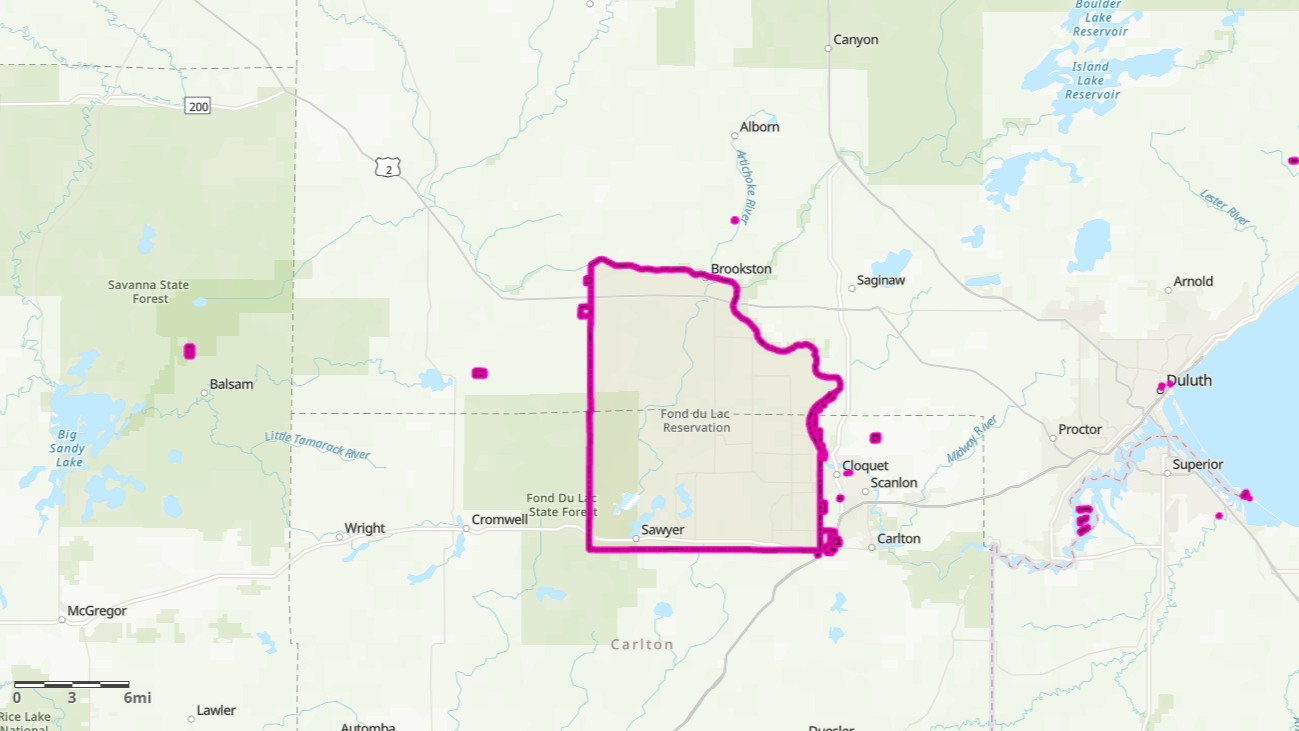
The Fond du Lac Band has over 4,200 enrolled members and census data from 2020 recorded an on-reservation population of 4,184 people. It should be noted, however, that a significant proportion of this population is comprised of non-Native members due to historical allotment.
The Fond du Lac Band government has been successful in creating a viable, sustainable homeland with robust services, economic opportunities, and cultural programs that draw and keep its members in the community. However, the still-high Native population underscores the critical importance of the Band's contemporary governance, resource management, and educational initiatives, as they directly serve a large, concentrated, and engaged population.
Listen
Hear the correct way to pronounce important Ojibwe words below. Many more example audio recordings are available in The Ojibwe People's Dictionary.
Ojibwe language audio copyrighted by The Ojibwe People's Dictionary. The audio is licensed under under Creative Commons Attribution-NonCommercial-ShareAlike 3.0 Unported License (http://creativecommons.org/licenses/by-nc-sa/3.0/).
A note on word choice
In some form, Anishinaabe, Ojibwe, and Chippewa can all be used to refer to the same People. However, many Native members strongly prefer the usage of Anishinaabe, as it is the word they use to call themselves. Ojibwe is an acceptable term to use by outsiders and is often used if a distinction between Nations is needed. The usage of Chippewa arose from a mispronunciation by European settlers; and so members of the Fond du Lac Ojibwe tend to use Anishinaabe or Ojibwe.